Romania’s industrial and logistics space market remained active in the first half of 2026, but most of the demand and new deliveries were concentrated in Bucharest and the localities surrounding the Capital.
In the first six months of the year, 445,779 sqm of new industrial and logistics space was leased nationwide, a volume close to half of the result recorded for the whole of 2025. Activity started at a faster pace in the first quarter, after which demand slowed during the April–June period. In Bucharest, a total of 299,261 sqm of new industrial space was leased, representing 67% of the total.
This development shows that the market continues to benefit from interest from companies, but also that expansion or relocation decisions are being taken more cautiously, in an economic context in which costs, consumption and trade developments are being closely monitored, said Nicolae Ciobanu, Managing Partner – Head of Advisory at Fortim Trusted Advisors, a member of the BNP Paribas Real Estate alliance.
Bucharest attracted the largest share of demand
In the second quarter of 2026, take-up, namely contracts for new space, relocations and expansions, reached 161,565 sqm nationwide. If renegotiations of existing contracts are also included, total leasing activity amounted to 326,727 sqm.
The results were lower than those recorded in the first quarter, but cumulatively, the volume registered at mid-year remains at a level comparable with the first part of last year.
Bucharest and the surrounding area clearly dominated the market. In the second quarter, companies contracted 126,726 sqm of new space here, equivalent to approximately 78% of national take-up.
When renegotiations are included, the volume transacted in Bucharest and the surrounding area reaches 248,506 sqm, representing approximately three quarters of all leasing activity in Romania.
The concentration of demand around the Capital is explained by access to the country’s largest consumer market, proximity to the main transport hubs and the availability of labour. At the same time, most major logistics park developers are already present in this area and can respond more quickly to demand for large spaces.
93% of new space was delivered in Bucharest and the surrounding area
The concentration of the market is also visible in the case of new developments. In the second quarter, 93% of the volume of Class A industrial space delivered in Romania was completed in Bucharest and the neighbouring localities.
This very high share shows that developers continue to consider the Capital the safest destination for new investment. Demand is more diversified, coming from logistics, retail, e-commerce, manufacturing and distribution companies, while the risk of spaces remaining vacant is generally lower than in smaller cities.
Over the medium term, the development of road infrastructure could also support other regional centres. However, in the first half of 2026, Bucharest remained the main driver of the market.
How 2026 compares with previous years
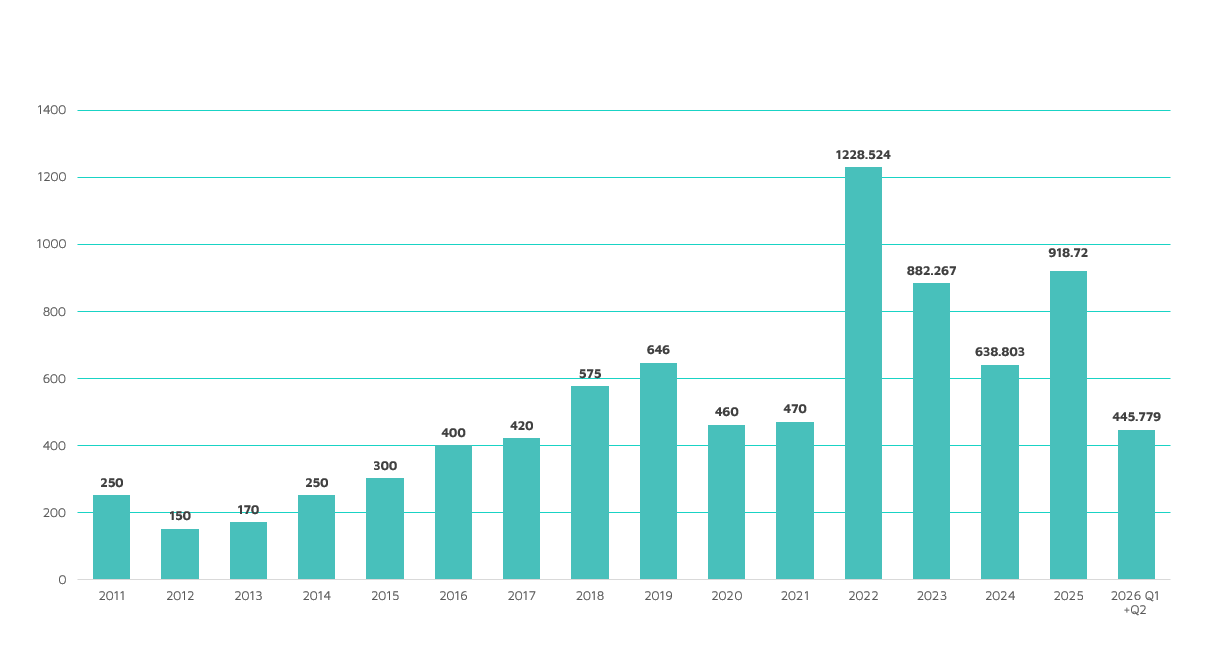
The chart showing the evolution of industrial take-up indicates that the market grew gradually between 2012 and 2019, from approximately 150,000 sqm to 646,000 sqm annually. After the decline in 2020 and the relatively stable result in 2021, 2022 brought a record of more than 1.22 million sqm, against the background of the accelerated expansion of the logistics sector and companies’ need to reorganise their supply chains.
In 2023, the volume moderated to approximately 882,000 sqm, while in 2024 it fell to around 639,000 sqm. However, 2025 marked a strong recovery to almost 919,000 sqm, the second-highest result in the period analysed, after the record set in 2022.
The volume of 445,779 sqm recorded in the first half of 2026 represents approximately 49% of the 2025 total, 51% of the 2023 volume, 70% of the full-year 2024 result and 36% of the record level recorded in 2022.
If the pace from the first half of the year were maintained, the market could end the year close to the 900,000 sqm threshold, a result comparable with 2023 and 2025. However, the slowdown observed in the second quarter suggests that such an estimate should be viewed with caution.
Developments in the second half of the year will depend largely on the completion of several large transactions and potential pre-lettings. A few major contracts can quickly change the annual result, because the industrial market is significantly influenced by transactions exceeding several tens of thousands of square metres.
The investment market remained almost at a standstill
Unlike the leasing segment, the market for transactions involving modern industrial properties recorded very limited activity. No investment transaction involving such assets was recorded in the second quarter.
The only industrial transaction in Romania in 2026 was brokered by Fortim Trusted Advisors and involved the sale of a warehouse in Bucharest, with a value of up to EUR 1 million.
Investors are, however, continuing negotiations for a significant portfolio of industrial parks. If this transaction is completed by the end of the year, it could significantly change the investment market results.
Outlook for the second half of the year
The first half of 2026 confirms the existence of consistent demand for industrial and logistics space, but also an increasingly strong concentration around Bucharest.
The market is no longer advancing at the exceptional pace recorded in 2022, but it remains above the levels registered before the pandemic. For the rest of the year, the main elements to watch will be the emergence of large pre-lettings, the evolution of consumption, investments by manufacturing and distribution companies, as well as the completion of transactions currently under negotiation.
In the absence of very large contracts, activity in the second half of the year could be more moderate. Even in this scenario, the result from the first six months indicates that 2026 could remain a solid year for Romania’s industrial and logistics market.