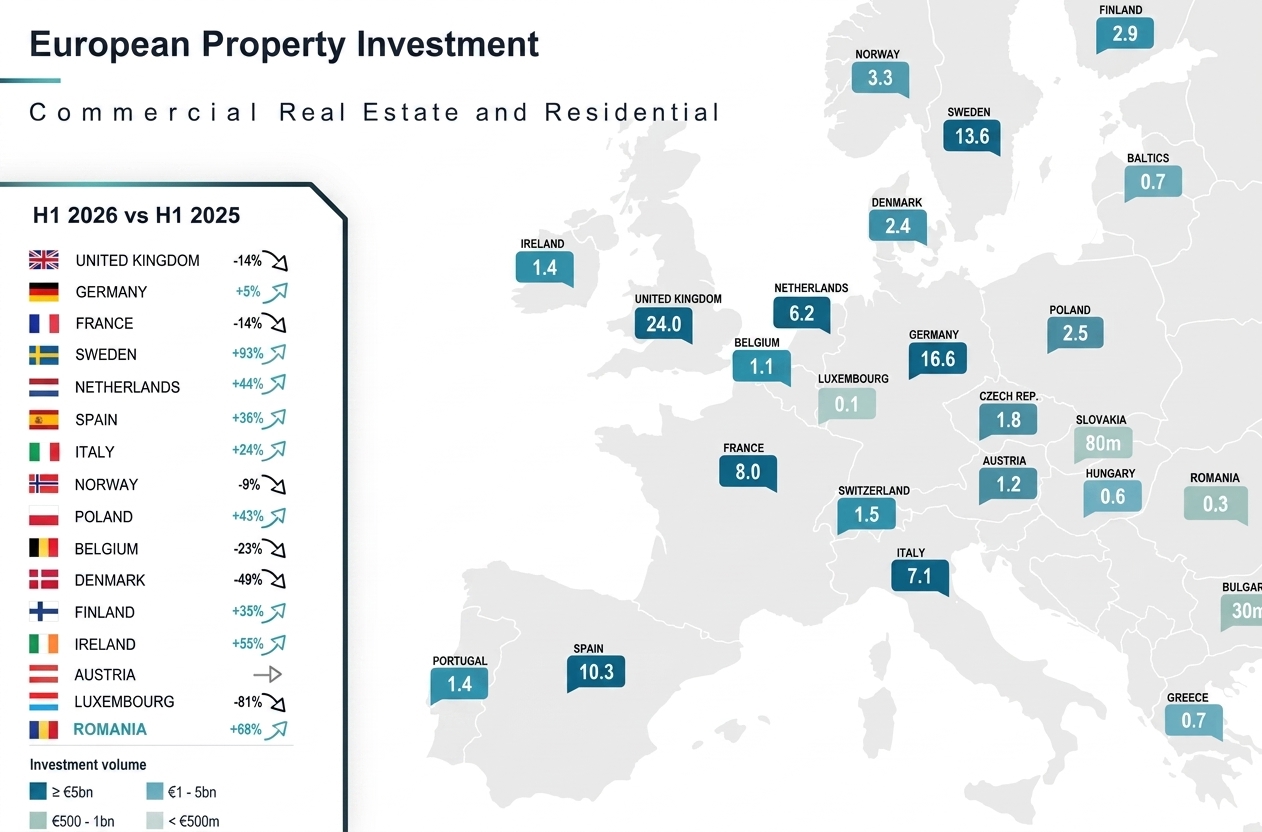
The European real estate investment market continued to advance over the past 12 months, although the pace of growth moderated in the first half of 2026 amid geopolitical uncertainty and a less predictable monetary environment. According to a study conducted across the BNP Paribas Real Estate Alliance, total investment in commercial real estate in Europe exceeded €187 billion in the 12 months ending in June 2026, up by approximately 10% compared with the previous corresponding period.
For Romania, the information included in the European study is provided by Fortim Trusted Advisors, BNP Paribas Real Estate’s exclusive partner for the local market. Fortim is part of the Alliance’s international network and contributes Romanian market data and analysis, integrating local developments into the broader European perspective on the real estate sector.
Investment dynamics across Europe vary significantly from country to country
After a period of sustained recovery over the past two years, the European market began to show signs of slowing in the first half of 2026. Geopolitical tensions have made investors more cautious, while the inflation outlook adds further complexity. Monetary policy, which until recently provided a more supportive framework for the real estate market, could enter a new phase in which the risk of key interest rate increases can no longer be excluded.
Nevertheless, investment volumes in the first half of 2026 increased by double digits compared with the same period of 2025 in Spain (+36%), Poland (+43%), Italy (+24%), the Netherlands (+44%) and Romania (+68%), while Germany recorded single-digit growth (+5%), signalling positive momentum in these commercial real estate markets. By contrast, declines were recorded in the UK, Belgium, Norway and France.
In a European context in which investors are paying greater attention to risk and income predictability, Romania continues to offer opportunities for local, regional and international capital. Interest remains, but decisions are being made more selectively, with a focus on well-positioned assets capable of generating stable long-term income, says Nicolae Ciobanu, Partner – Head of Advisory at Fortim Trusted Advisors.
Against this backdrop, the cautious stance of central banks provides only limited support to the real estate sector, without removing uncertainty over the future direction of interest rates. However, the slowdown in activity observed in 2026 is seen more as a moderation of the recovery rather than a major change in the market cycle. At present, there are no strong systemic factors pointing to a sharp decline, but neither are there sufficiently strong catalysts to drive a significant acceleration in investment activity.
As a result, investors are increasingly focusing on the recurring income generated by properties rather than on the prospect of rapid increases in asset values. A property’s ability to generate stable income, tenant quality, lease duration and cash-flow sustainability are becoming increasingly important acquisition criteria. At the same time, investor selectivity is increasing, while a wait-and-see approach is becoming more visible across Europe.
Against this background, Romania attracted approximately €304.9 million in commercial real estate investment in the first half of 2026, of which approximately €153.3 million was recorded in the second quarter alone. The local market continues to be dominated by local and regional investors, giving it a different structure from the major Western European markets, which are more dependent on global institutional capital flows.
Offices represented the most important segment of the Romanian market in the first half of the year. They accounted for 68% of total investment volume in H1 2026, even though activity slowed in the second quarter. Between April and June, only three office transactions were completed, with a combined value of approximately €73 million, compared with around €135 million in the first quarter. In Q2, offices therefore represented approximately 47% of total transaction volume.
Another transaction that could have contributed to the office segment volume was postponed. A prime, medium-sized office building located in a central area is currently under an exclusive acquisition mandate, but the transaction, initially scheduled for the second quarter, was not completed within the expected timeframe.
At the same time, retail, and particularly the retail park segment, recorded strong activity, attracting approximately €77 million in investment. Interest from local and international investors in this type of property remains high, supported by the defensive nature of proximity retail formats and by the growth prospects for consumer spending in regional cities.
The outlook for the second half of the year could, however, significantly change the size of the Romanian market. Several major portfolio transactions are currently under negotiation in the industrial and retail segments, and if they are completed by year-end, their combined value could exceed €500 million. Such a development would substantially increase the annual investment volume and confirm that, despite a more cautious approach at European level, capital remains available for well-positioned assets and portfolios with solid income prospects.