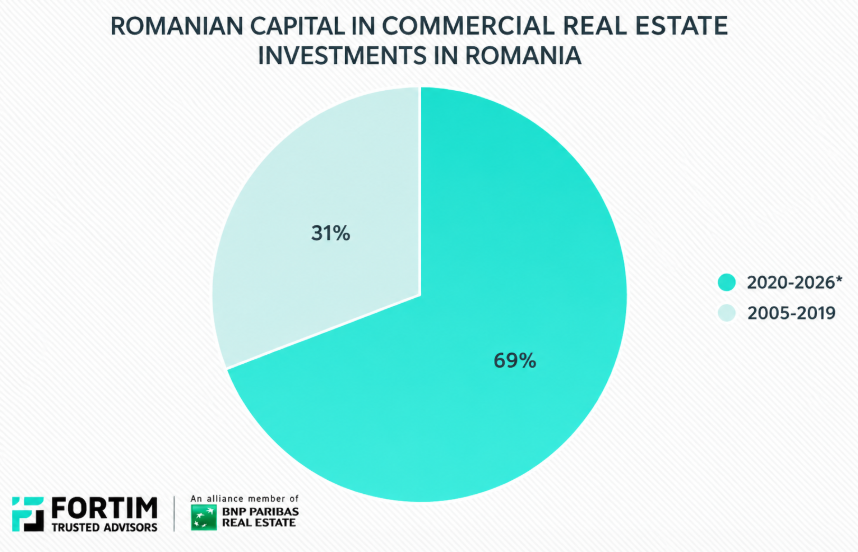
Over the past 20 years, Romanian investors have acquired commercial real estate assets with a cumulative value of EUR 2.066 billion, according to an analysis by Fortim Trusted Advisors, a member of the BNP Paribas Real Estate Alliance. As much as 69% of this amount has been invested since 2020, highlighting the increasingly important role of domestic capital in the real estate market.
During the first part of the period under review, particularly throughout the 2000s, Romanian investors had only a sporadic presence in the market, with some years recording no significant acquisitions involving local capital.
Romanian capital has entered a new stage of maturity. While 10 to 15 years ago local investors tended to appear only occasionally in commercial real estate transactions, today there are Romanian buyers who consistently assess income-generating assets and compete directly with regional and international investors. For entrepreneurs who have accumulated capital through their core businesses, commercial real estate has become a natural way to diversify their investments, preserve capital and generate recurring income over the long term, said Nicolae Ciobanu, Managing Partner – Head of Advisory at Fortim Trusted Advisors.
The first major acquisition involving Romanian capital was recorded in 2010, when a Bucharest-based investor acquired Tiago Mall in Oradea, which was insolvent at the time, for EUR 30.5 million.
In the years that followed, Romanian investors gradually moved from opportunistic acquisitions towards a strategy of capital diversification through income-generating commercial properties. Office buildings, shopping centres and retail units, retail parks and industrial properties consequently became a distinct investment category for local entrepreneurs and investors.
This trend accelerated after 2020. The peak was reached in the fourth quarter of 2022, when Romanian investors deployed EUR 525.4 million into commercial real estate, accounting for approximately 90% of the capital invested in the Romanian real estate market during that quarter. Acquisitions by Pavăl Holding played a significant role, with the company purchasing eight office buildings that year for a combined value of approximately EUR 470 million.
Who Are the Romanian Investors of 2026?
During the first two quarters of 2026, the commercial real estate investment market was characterised by a strong presence of local and regional capital. Investors from Romania, Czechia and Hungary together accounted for approximately 48% of the total transaction volume, with Romanian investors alone representing around 22%.
According to Fortim data, Romanian capital invested in commercial properties totalled EUR 79 million in the first six months of 2026. The largest transaction completed by a Romanian buyer during this period was the acquisition of the Record Park office building in Cluj-Napoca by FIA BT Property.
The presence of investment vehicles such as FIA BT Property indicates a further maturing of domestic capital. Alongside traditional entrepreneurs and private investors, the market is seeing an increasing number of investment structures capable of targeting larger assets and building long-term real estate portfolios.
Another active category of investors consists of entrepreneurs from IT, healthcare services, retail and other sectors who reinvest part of their capital in income-generating properties. They primarily target retail units leased to strong operators, retail parks, smaller office buildings and hotels, generally with budgets of up to EUR 10 million per acquisition. Their main investment criteria include tenant quality, lease duration, income predictability and ease of property management.
There is also a smaller segment of Romanian investors building portfolios worth tens or even hundreds of millions of euros, including in small and medium-sized cities. One example is the series of Brico Dépôt store acquisitions carried out by the investor behind the Altex retail network, which has resulted in the creation of a commercial real estate portfolio worth several tens of millions of euros.
We are effectively seeing two categories of Romanian capital growing in parallel. On the one hand, there are investors with budgets of several million euros who pay close attention to yields, tenant quality and the property’s cash flow. On the other hand, a category of local investors and investment vehicles capable of acquiring large assets or building portfolios is beginning to consolidate. This evolution is important for the market because it broadens the buyer base and reduces the dependence of Romanian real estate transactions solely on the investment cycles of international capital, said Ștefan Oana, Head of Capital Markets at Fortim Trusted Advisors.
The evolution of recent years therefore points to a structural shift: Romanian capital is no longer merely an opportunistic source of funding for individual transactions but is increasingly becoming a consistent component of Romania’s commercial real estate investment market.